
Blaine County Three-Day Release Source
Blaine County does not publish a page labeled “72-Hour Releases.” The Sheriff's Office Recent Arrests wrapper opens one mixed feed that research observed spanning about four days, or roughly 96 hours. It includes both people still in custody and those who departed. A three-day result comes from selecting released rows whose exact timestamps fall inside the prior 72 hours. The calculation belongs to the reader, not the county.
The extra day in the source gives enough room to set a three-day cutoff in most checks, but it is not a promised archive. The header states the source range and an “as of” time. Record both. Because the display rolls forward, an entry near its oldest edge can vanish, and the county has not stated how often the live system refreshes.
Check Blaine County 72-Hour Releases
Open the official live feed and use its own update time as the reference point. Booking Date is not the filter. A person may have been booked before the three-day span and released inside it. Identity also needs more than a matching name.
- Note the feed's “as of” date and time, then subtract 72 hours.
- Scan for rows that include a Release Date. Rows without one may describe current custody.
- Keep only timestamps at or after your cutoff and before the stated update time.
- Compare photo, age, hometown, offense text, booking time, and arresting agency to avoid a false match.
- Check the current roster for continued custody, then call 208-788-5564 when the sources conflict.
Use Blaine County 24-Hour Releases when only same-day departures matter. Both methods read the same county source but apply different time limits.
Blaine County Release Row Fields
A released row ties identity and booking context to a physical departure time from the Blaine County Detention Center. The source may not state a release type or destination, so its claims must stay narrow.
| Field | How to read it |
|---|---|
| Photo, name, age, hometown | Combined identity checks; none should stand alone. |
| Offenses | Booking-related charge or hold text, not a final case outcome. |
| Arresting agency | Agency connected to the arrest, which may own a separate incident report. |
| Booking Date and time | Start of the recorded county booking, not the three-day filter field. |
| Release Date and time | The field used for the 72-hour cutoff and positive proof of BCSO departure. |
| Status | Current or released context in the mixed display. |
If a transfer is possible, request the disposition, nonexempt destination, and any code legend. The exact Release Date proves departure from BCSO custody, not freedom from every agency.
Blaine County Weekend Release Checks
A 72-hour span is most helpful after several days away from the feed. It can cover much of a weekend in one pass and reduces the chance that a Friday or Saturday departure is missed during a Monday check. Still, the source's live range controls what is visible. A holiday does not extend the online display by rule, and no county promise supports such an assumption.
Release processing can cross a day boundary. A judge may authorize bond or another release before detention receives and completes the paperwork. The jail handbook says timing depends on arrest circumstances, release type, facility schedule, and paperwork processing. Use the physical Release Date rather than the court order time when deciding if a departure fits the three-day window.
For a specific person whose row is gone, follow the named-person verification routes on the Blaine County released-inmate home page. Court authority and jail departure answer different questions and should be paired.
Blaine County Release Record Fallbacks
Once a row ages out, submit the sheriff's public-records form. Identify the full name, date of birth, approximate booking date, arrest location, and BCSO case number if known. Request the booking and release times, release type, nonexempt transfer destination, and booking photograph only if it is needed to identify the correct event. The form warns that a court case number by itself cannot identify a sheriff record.
IDOC is the right next source only if state custody or supervision is plausible. A result marked Discharged with a date means an IDOC sentence was satisfied, while “In community” reflects an active supervision link. VINE can send a custody-change alert, but current Blaine jail coverage should be confirmed in the live selector. Neither source substitutes for the county release record.
- Community release
- Departure from custody under bond, court order, dismissal, time served, or county sentence completion.
- Transfer
- Movement into another agency's custody rather than return to the community.
- Discharge
- Completion of an IDOC sentence or supervision term, shown separately from a county-jail exit.
Why Blaine Release Rows Mix
The most valuable county release source is labeled Recent Arrests. That label reflects the feed's mixed purpose: current bookings remain alongside released entries. Released rows uniquely add an exact Release Date and time while keeping the photograph and booking facts. No separate 24-hour or 72-hour view was found, and no sheriff inmate app was verified.
The official county wrapper confirms the source, while the live feed supplies the changing rows. This combination is stronger than a copied list because it preserves agency provenance and an update time. It also demands careful wording. Say that BCSO recorded departure, then seek destination details before claiming the person went home.
Blaine County Recent Feed View
The official Recent Arrests wrapper identifies the county source used for three-day checks.
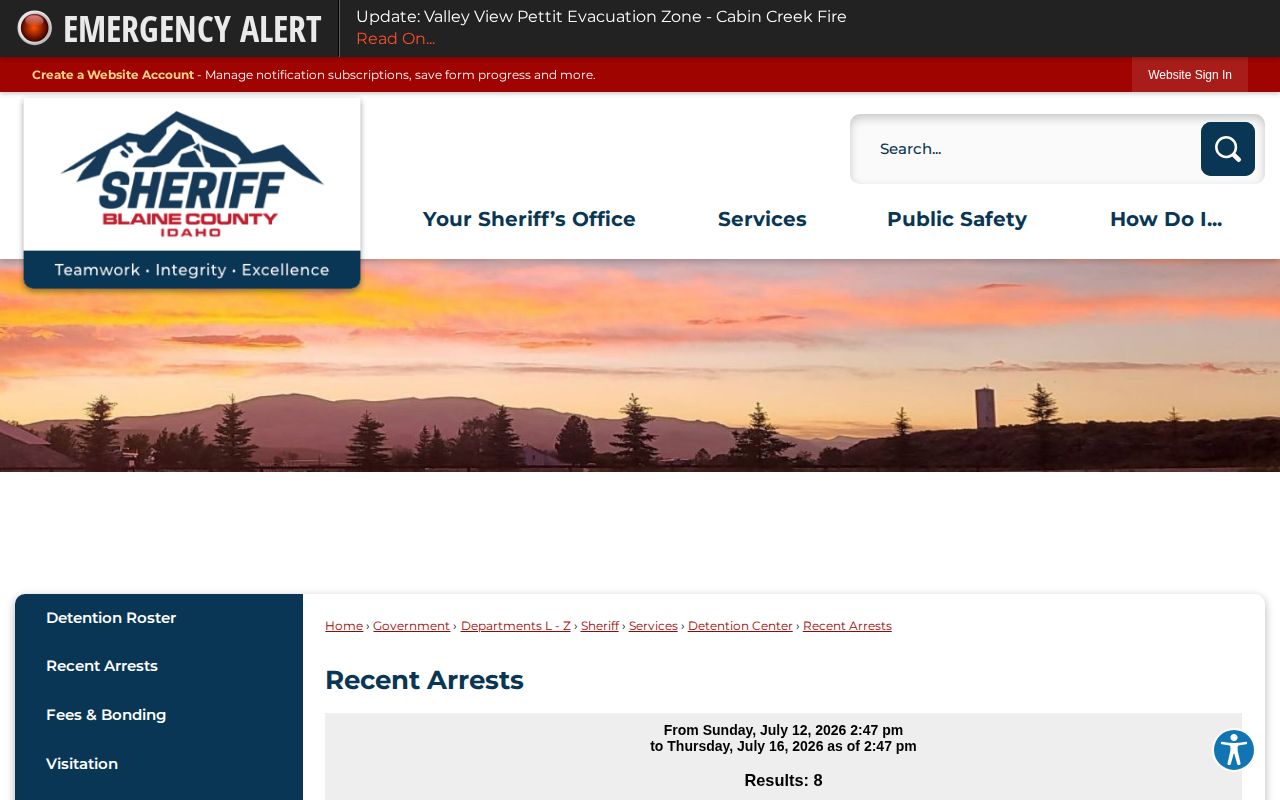
The captured county page provides the official entry point. The linked live feed supplies the timestamps that must be compared with the 72-hour cutoff.
The underlying jail record can answer what the public row leaves open. A useful request asks for the exact release disposition and any nonexempt destination code. If it says transfer to IDOC, ICE, another county, a hospital, or another agency, the Blaine departure was continued custody. If it says bond, dismissal, time served, or sentence completion, community release may be supported, subject to any other hold.
iCourt adds the judicial side. It can show bond, disposition, judgment, sentence, probation, or a later event. Yet a court order may precede physical exit because detention must receive and process paperwork. The court record explains authority, while the feed or jail record supplies the departure moment.
Blaine County Release Identity Checks
Do not merge two rows because the names look alike. The county feed offers age, hometown, photograph, arresting agency, offense text, and booking date as cross-checks. An IDOC result adds birth year, IDOC number, sentencing county, and case number when state supervision or custody exists. Each identifier belongs to its own system.
Dynamic sources can disagree for ordinary reasons. The roster may lag after an order, VINE may report a feeder change before a public page updates, and an IDOC intake may not appear as soon as the county row vanishes. Record observation times and let the agency with physical custody establish departure. If no positive record appears, describe the result as unresolved.
Beyond Blaine County's Three Days
An older county release belongs in a written sheriff request and, when relevant, iCourt. A state transfer belongs in the IDOC Resident/Client Search. A federal sentence belongs in the BOP locator, while a documented ICE transfer belongs in the ICE locator. These systems cannot be collapsed into one status because a person may leave one authority and enter another on the same day.
No official Blaine booking-record retention term was found. The live feed's short span therefore says nothing about whether the jail-management record still exists. Ask the custodian to search the active system, archive, or other retained format.
The sheriff request form accepts mail, pickup, or email delivery and asks for residency details. Blaine publishes different response bands for residents and nonresidents, so the live feed remains the fastest option while a row is visible. A focused request should seek existing fields instead of asking staff to write a new account. Add the release disposition, transfer agency, and code legend only when those items are needed to interpret the departure.